


The Bhagavad Gita
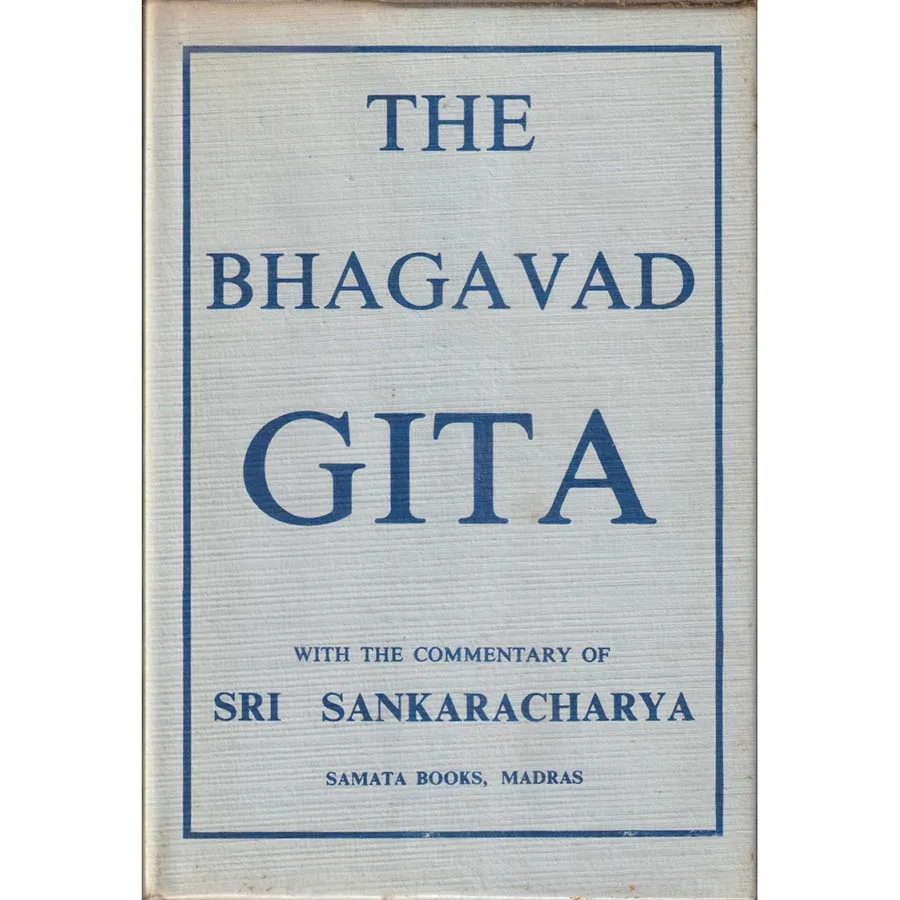
Publisher: Samata Books
Format: Hardback
ISBN: none
The Bhagavad Gita (1981) by Sri Sankaracharya – Samata Books – ISBN: None – Condition: Good
There are books which tell you how to cook supper, books which tell you how to repair a carburettor, and then there are books which calmly attempt to explain duty, existence, the self, reality, morality, action, detachment and the nature of the divine. The Bhagavad Gita belongs firmly in the latter category, which does make it slightly more ambitious than the average paperback.
This 1981 edition from Samata Books presents the Bhagavad Gita with the philosophical tradition of Sri Sankaracharya, one of the most influential commentators in Indian philosophy. The text itself forms part of the Mahabharata and takes the shape of a dialogue between the warrior Arjuna and Krishna, conducted at what can only be described as an extremely inconvenient moment: immediately before a battle.
Arjuna, faced with the prospect of fighting people he knows, quite reasonably has something of a crisis. Krishna responds not with a cup of tea and a suggestion that everyone sleep on it, but with a sweeping discussion of duty, action, knowledge, devotion, the soul, the universe and the proper way to understand one’s place within it.
From there, matters become considerably deeper.
The Gita explores questions that have occupied philosophers, theologians and ordinary people for centuries: How should we act? What are we responsible for? Should we pursue results or concentrate on the action itself? What exactly is the self? Why are we here? And, perhaps most importantly, why does attempting to answer any of these questions invariably produce three more questions?
Sri Sankaracharya’s association with Advaita Vedanta gives this edition particular philosophical interest. His thought emphasises non-duality and the idea that ultimate reality is not quite arranged in the neat little compartments we usually imagine it to be. Which is reassuring in one sense and slightly inconvenient in another, especially if you were hoping reality came with labelled drawers.
This is consequently not light reading in the traditional sense. Nobody is murdered on page three to get the plot moving, there are no detectives, and there is disappointingly little discussion of property prices. Instead, the reader gets several thousand years of accumulated philosophical weight compressed into a compact volume that can make an ordinary Tuesday afternoon unexpectedly metaphysical.
It is also one of those books that can be read in several different ways. Some approach it as sacred scripture, some as philosophy, some as literature, and some simply because they bought it second-hand and thought, “I really ought to understand this.” All are perfectly respectable reasons, although the last is probably how quite a few copies have ended up on bookshelves.
This copy is in Good condition. There is no ISBN, which is hardly surprising for this sort of edition and does lend it a pleasing air of having existed before databases became convinced that everything in civilisation needed a thirteen-digit number.
Ideal for readers interested in Hindu philosophy, Vedanta, comparative religion, Indian thought, classical spiritual texts, or anyone who has reached the stage in life where another crime novel simply will not answer the larger questions.
Another thoughtful survivor from Crappy Old Books — for those occasions when what you really need is not another possession, but a book quietly suggesting that attachment to possessions may have been the problem all along.
Keep browsing: See more Religion books Other books by Sri Sankaracharya
